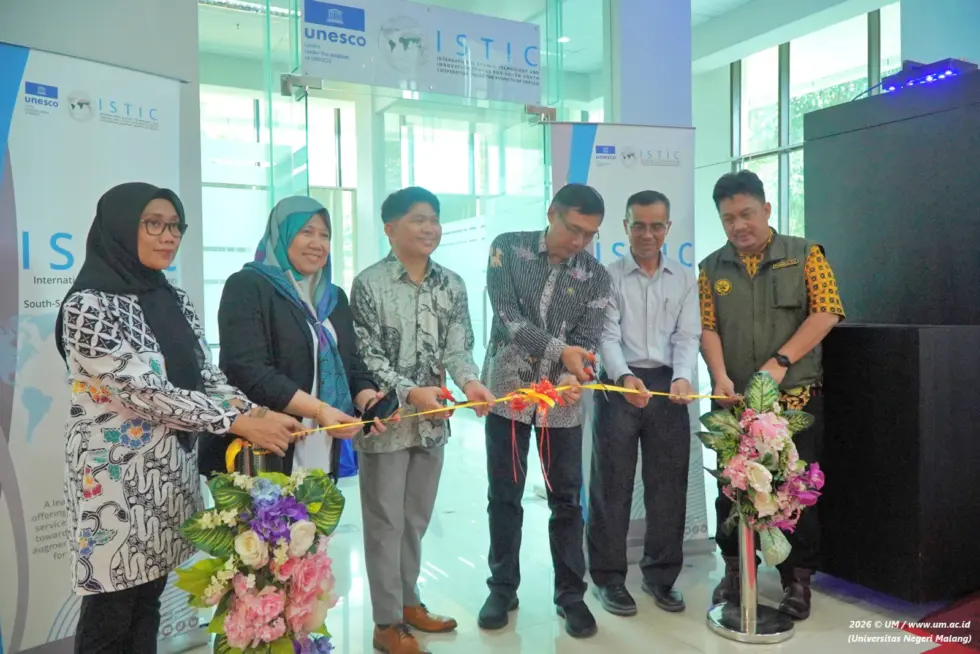
Universitas Negeri Malang (UM) continues to advance its global engagement by officially becoming the host institution for a branch of the International Science, Technology and Innovation Centre for South-South Cooperation under the auspices of UNESCO (ISTIC). The inauguration took place at the Glass Room of Publika, UM Rectorate Building, on Tuesday (May 5), marking a significant step in strengthening UM’s position within the global science collaboration network among countries of the Global South.
This milestone represents a strategic turning point for UM in promoting a new paradigm of scientific development that is more inclusive, collaborative, and sustainable. The inauguration ceremony was attended by UM Rector Hariyono, university leaders, and ISTIC delegates, including Mohd Baryaruddin Abdul Rahman, Tongbu Sharizad Tengku Dahlan, and Intan Sazrina Saimy.
In his remarks, Prof. Hariyono emphasized that this collaboration opens broad opportunities to integrate natural sciences with social sciences and humanities. He highlighted the importance of developing science that remains deeply connected to social and cultural roots.
“Science and technology are part of culture. Therefore, their development must be grounded in comprehensive values and perspectives,” he stated.
Meanwhile, ISTIC Chairman Prof. Mohd Baryaruddin Abdul Rahman noted that this partnership not only expands academic networks but also elevates the strength of local wisdom as part of the intellectual wealth of Global South countries. He described UM as a highly strategic partner with outstanding international collaboration capabilities.
“There are thousands of universities in Indonesia, but Malang is the best for us, especially in terms of interaction and cooperation. Many working processes become much easier,” he remarked.
He further emphasized ISTIC’s important role in fostering holistic talents, particularly in the development of science policy.
“The main role of ISTIC is to produce holistic talents, especially in building science policies that create broad impacts for society,” he added.
The presence of ISTIC at UM is expected to strengthen the contribution of higher education institutions in addressing global challenges through relevant research and innovation. This initiative is also aligned with the United NationsSustainable Development Goals (SDGs), particularly Goal 4: Quality Education, by promoting inclusive and globally oriented higher education.
Furthermore, this step reaffirms UM’s commitment to becoming a driving force in advancing science and knowledge rooted in local values while generating global impact. The collaboration is expected to serve as a catalyst for innovative research and science policies capable of addressing the evolving needs of global society in a sustainable manner.
Reporter: Keynisya Pentania Sofyani – Internship Public Relations UM
Photographers: Nabila Nisrina Rihab and Abdul Aziz Tri Nugroho – Internship Public Relations UM
Editor: Muhammad Salmanudin Hafizh Shobirin – Public Relations UM
 English (UK)
  Bahasa Indonesia