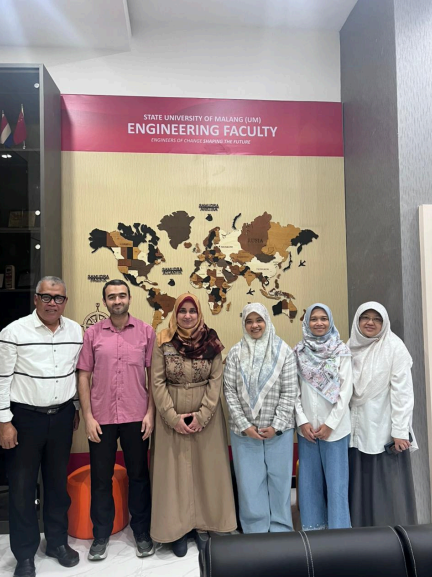
Malang — What once seemed like one of the most abstract topics in engineering mathematics became strikingly relevant for Civil Engineering students at Universitas Negeri Malang (UM) during an international guest lecture on Tuesday, 24 February 2026.
The session, titled “The Applications of Trigonometric Integrals in Civil Engineering,” featured Dr. Shaymaa M.H. Darwish from Universiti Teknologi Malaysia (UTM), an international academic whose expertise in applied mathematics and engineering analysis brought fresh insight into the classroom. The lecture was initiated through academic collaboration with Dr. Ir. Nindyawati, S.T., M.T., Head of the Civil Engineering Study Program at UM.
Held at the 4th Floor Hall of Building B11, Faculty of Engineering, the event gathered Civil Engineering students from the 2025 cohort for an engaging session that combined rigorous academic content with real-world applications.
Drawing from her experience, Dr. Shaymaa demonstrated how trigonometric integrals play a crucial role in engineering practice. She explained their application in calculating total structural displacement, analysing accumulated stress under dynamic loads, evaluating energy within mechanical systems, and modelling force distribution across structural elements.
Her presentation highlighted a key engineering principle: understanding cumulative effects through integration provides insights that cannot be captured through isolated, point-based analysis. By bridging theory and practice, she helped students see how advanced mathematics directly informs safer, more efficient, and more reliable infrastructure design.
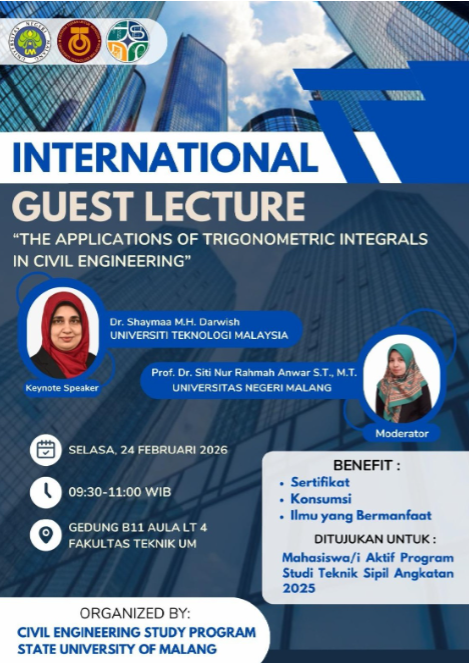
The session, moderated by Prof. Dr. Siti Nur Rahmah Anwar, S.T., M.T., also featured an interactive discussion, where students engaged directly with the speaker, exploring practical challenges and applications in civil engineering.
Beyond its academic value, the presence of an international expert in the classroom reflects UM’s ongoing commitment to global engagement and collaborative learning. Exposure to diverse academic perspectives not only enriches students’ understanding but also prepares them to operate in an increasingly interconnected professional environment.
The initiative also contributes to the achievement of the Sustainable Development Goals (SDGs), particularly SDG 4 (Quality Education), SDG 9 (Industry, Innovation and Infrastructure), and SDG 17 (Partnerships for the Goals) through strengthened international academic collaboration.
Through programmes like this, Universitas Negeri Malang continues to demonstrate that global collaboration can transform the learning experience—turning even the most complex mathematical concepts into powerful, practical tools for future engineers.
Author: Dr. Ir. Nindyawati, S.T., M.T.
Translated and adapted by: Office of International Affairs, Universitas Negeri Malang
 English (UK)
  Bahasa Indonesia