
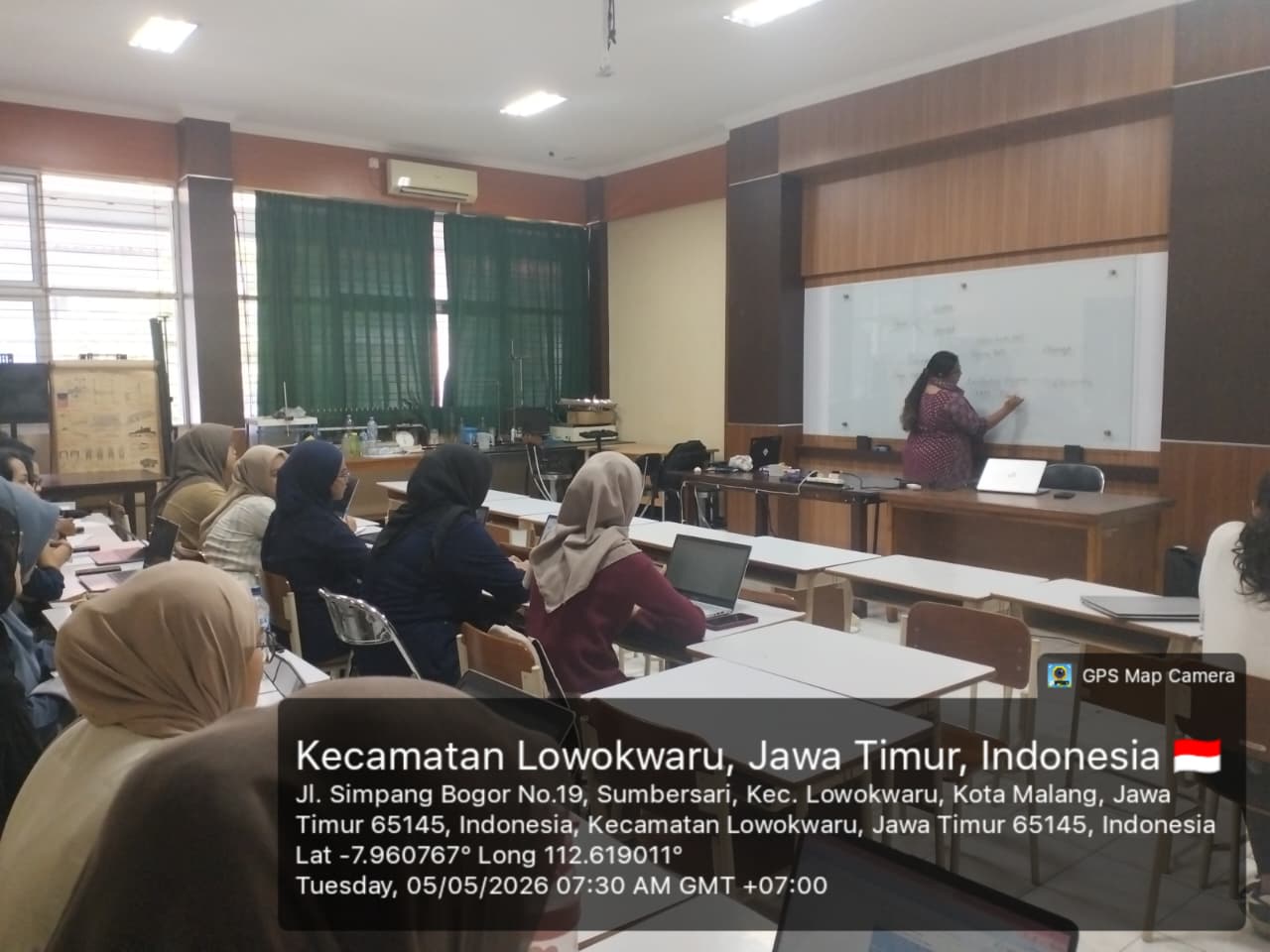
Malang — The Department of Physics, Faculty of Mathematics and Natural Sciences, Universitas Negeri Malang (UM), through its World Class University (WCU) Program, held an International Guest Lecture titled “Polymers as Next Generation Energy Materials” on Tuesday, 5 May 2026. The session took place at Room A19-320 and formed part of the university’s ongoing efforts to strengthen internationally oriented academic activities.
The lecture featured Dr. Suneyana Rawat from the Trinity Institute of Innovation in Advanced Studies, Greater Noida, India, as the keynote speaker. Her participation reflects UM’s commitment to expanding global academic engagement and enriching the perspectives of both students and faculty, particularly in the fields of advanced materials and energy technology.
The session aimed to introduce participants to the growing role of polymers as next-generation energy materials. In modern materials science, polymers are no longer viewed solely as lightweight and flexible substances; they are increasingly recognised for their potential in a wide range of energy-related applications.
The topic is especially relevant in light of the global demand for more efficient, sustainable, and scalable energy technologies. Polymers can be engineered, modified, and combined with other materials to achieve specific functional properties. This versatility has led to their increasing use in the development of energy storage devices, sensors, functional membranes, batteries, supercapacitors, and renewable energy technologies.
During the lecture, Dr. Suneyana Rawat highlighted how the design and development of polymer-based materials can significantly contribute to future energy solutions. She emphasised that a strong understanding of polymer structure, properties, and functionality is essential for developing high-performance materials. The discussion also underscored that innovation in energy systems depends not only on device engineering but also on the careful design of the materials themselves.
Through this guest lecture, students gained valuable insights into current developments in energy materials research from an international academic perspective. The session also encouraged participants to broaden their scientific thinking and better understand the relationship between materials science and future energy challenges.
Beyond its academic value, the programme also supports the internationalisation of higher education by facilitating cross-border knowledge exchange. The presence of Dr. Suneyana Rawat contributed to fostering a more open, collaborative, and globally oriented academic environment at UM.
This activity aligns with the Sustainable Development Goals (SDGs), particularly SDG 4 (Quality Education), SDG 7 (Affordable and Clean Energy), SDG 9 (Industry, Innovation and Infrastructure), and SDG 17 (Partnerships for the Goals). Through international academic initiatives such as this, universities play a key role in advancing education, driving innovation in materials science, and strengthening global collaboration.
The successful implementation of this International Guest Lecture highlights Universitas Negeri Malang’s commitment to enhancing academic quality through the World Class University Program. It provides a platform for students and the academic community to gain new knowledge, expand professional networks, and strengthen their readiness to engage with the rapid development of science and technology.
Through initiatives like this, Universitas Negeri Malang continues to position itself as an institution actively promoting international collaboration and academic excellence. The lecture is expected to inspire students to further develop their competencies, expand their research perspectives, and contribute to the advancement of future energy materials.
Source: Mei Virina Luciawati, Kompasiana
Translated by Office of International Affairs, Universitas Negeri Malang
 English (UK)
  Bahasa Indonesia